Law firm training strategy sits in a uniquely frustrating position. The profession has never needed capable people more – regulatory pressure, AI disruption, talent attrition, and client demand for specialist expertise are all intensifying. Yet L&D teams in law firms routinely find themselves designing training programs that partners didn’t ask for, measuring completion rates that nobody reads, and fighting for budget against functions that speak the business’s language more fluently.
The TJ L&D Influence Report 2026 captures this tension across industries – and its findings land with particular force in legal. The report maps where L&D stands and where it needs to move. The headline finding applies directly to law firms: only one person out of 32 respondents said they feel “very ready” to turn evidence into action. The biggest blocker isn’t tools or tech. It’s access to the people who make decisions – in legal terms, that means partners, practice group heads, and the managing partner’s office.

| Highlights |
|---|
| 1. Partners and practice group heads are the biggest blocker to L&D impact in law firms – not systems, not budget. |
| 2. Talent, skills, and retention dominate L&D priorities – and legal has an acute version of this problem with attrition and specialist skill gaps. |
| 3. Only 3% of L&D practitioners feel “very ready” to turn evidence into action. |
| 4. Performance enablement — not CPD completion — is where legal L&D earns its relevance. |
| 5. Proximity to fee earners and practice leaders is the single most powerful lever legal L&D has right now. |
Why Legal L&D Keeps Getting Left Out of Conversations
When fee income drops or headcount pressure builds, law firm L&D often retreats to safe ground: mandatory compliance training, PSC requirements, induction programs. It feels productive. It isn’t always useful.
The report makes this structural problem visible. Respondents were asked what conversations L&D needs to start having with the business. The answers clustered around one theme: L&D needs to be in the room before the brief arrives, not after. One delegate put it plainly, “Involve us at the beginning of any conversation about change, projects, new roles.”
In a law firm, that means being part of conversations about lateral hires, practice group restructures, new service line launches, and technology rollouts – not being called in six weeks later to design an onboarding module. That sequence produces training that arrives too late to change behavior and too generic to feel relevant to a specialist team.
Proximity changes this. When legal L&D works alongside practice group heads, HR business partners, and BD leaders, it can shape what gets built before any training brief is written. That’s where influence starts -and in law firms, influence travels through relationships, not reporting lines.
What Blocks Legal L&D from Proving Its Value?
The report uses a four-part Readiness Enablers Index to map where the evidence-to-action chain breaks down. The four enablers are:
- Access to decision-makers on strategy, budget, and priorities
- Access to usable data – performance, HR, business metrics
- Time and permission to experiment
- Tools and support to scale what works
Decision-maker access came out as the most common bottleneck – and in law firms, this problem is structural. Partners are busy, billable, and often sceptical of L&D’s strategic value. Getting meaningful time with a practice group head to discuss capability gaps is harder than booking a training room.
NOTE: The access problem in law firms is more acute than in other sectors, given the billable hours model and the cultural deference to fee-earning activity over support functions – the report doesn’t address legal specifically, but the pattern maps clearly.
The report also names an emotional barrier that many legal L&D professionals will recognize. Andrew Jacobs, quoted in the report, describes the reluctance around measurement as a mix of capability and confidence: “What happens if what we do doesn’t actually make any difference?” In a profession where everything gets measured in time and money, that fear is amplified. But the report reframes it. Evidence isn’t a verdict on your work; it’s the language you need to earn the next conversation with a partner.
Is Law Firm Training Strategy Focused on the Right Targets?
When asked what results L&D most needs to focus on in 2026, respondents answered clearly:
- 43% talent, skills, or retention
- 30% revenue growth
- 13% cost reduction or efficiency
- 9% innovation or transformational change
- 4% customer or service experience
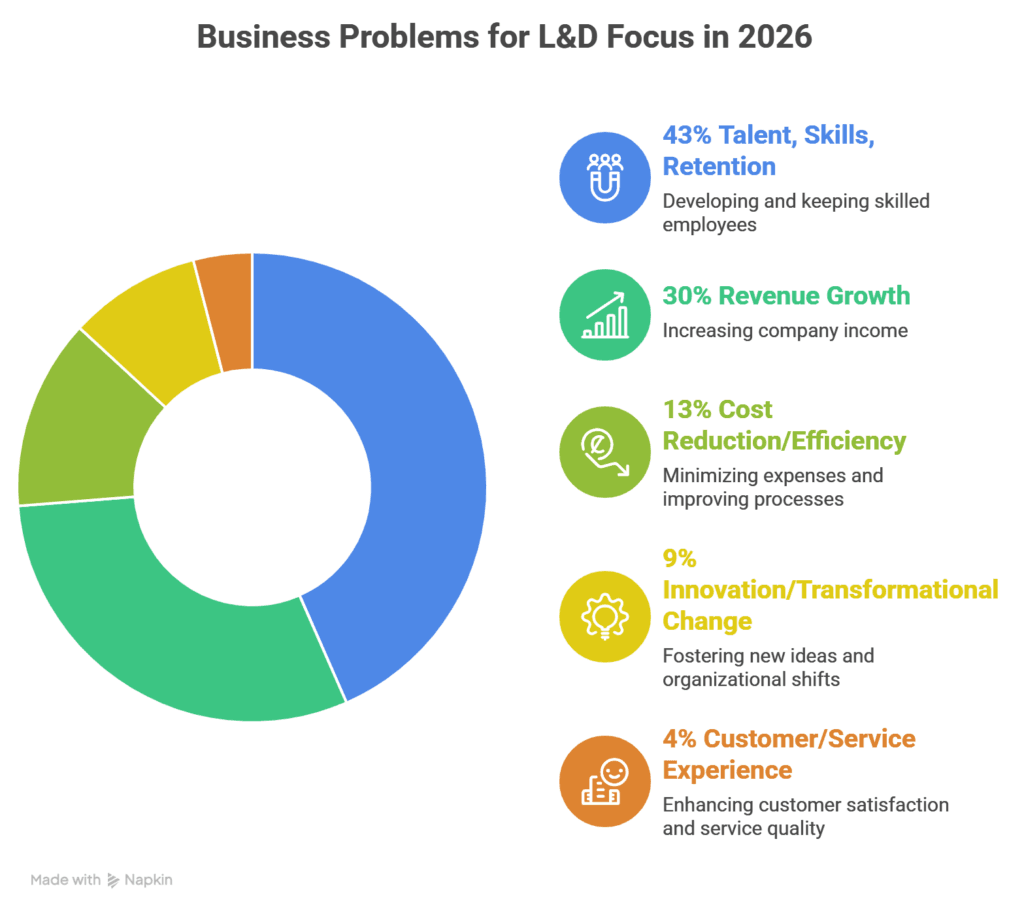
Talent and retention lead, and this maps directly onto one of legal’s most persistent problems. NQ attrition is expensive. Losing a three-year associate to a competitor or to in-house represents a significant investment walking out the door. Law firms that build genuine development pathways, rather than mandatory training calendars, retain people more effectively.
What’s striking is that only 30% of respondents connected L&D’s work to revenue growth. In a law firm, revenue is the conversation every partner is having every day. If legal L&D can’t connect its work to matter profitability, client retention, or fee earner productivity, it will always be seen as a cost, not a profit center.
What Does Performance Enablement Mean in a Law Firm?
Legal performance enablement shifts focus from evaluating past work to proactively empowering legal professionals through clear goals, continuous feedback, and technology, boosting productivity and retention.
The report draws a sharp line between delivering training and enabling performance. One delegate captured it directly: “Impact. It’s ALL about impact and what we do which impacts on the business bottom line, not how good our learning content is.”
In a law firm, performance enablement means removing friction from fee earner work – not scheduling another webinar. In practical terms, that looks like:
- Know-how resources and training delivered at the point of need
- Supervision and feedback structures that develop associates weekly, not just at annual appraisal
- Clear competency frameworks so associates know what progression actually looks like
- Matter debrief processes that capture learning from client work and feed it back into practice development
- AI tools that reduce research and drafting time, freeing lawyers for the judgment-intensive work clients actually pay for
The shift is from “here is a seminar on this topic” to “here is support for this specific task, at the moment the fee earner needs it.” That’s a fundamentally different design brief – and it requires legal L&D to be far closer to actual legal work than most teams currently are.
Gaëlle Watson, quoted in the report, frames the broader challenge: L&D needs to stop positioning itself as a content provider and move toward being a high-level performance partner to the business. In law, that means understanding how matters run, where associates get stuck, and what partners actually look for in a capable team.
Where Should Legal L&D Be Going Right Now?
This is the conversation most legal L&D teams avoid. The report is direct: stopping activity is a strategic act, not a failure.
The report identifies three categories of work worth keeping, dropping, or doubling down on.
Keep work that practice group heads requested early, that connects to measurable outcomes, and that fee earners actually use when the pressure is on.
Drop training that exists because it always has – generic soft skills programmes with no connection to practice reality, tick-box compliance modules that partners sit through on mute, and post-training surveys that produce data nobody acts on.
Double down on proximity to practice leaders, evidence that travels in the language that partners trust, and performance support that sits inside the workflow rather than outside it.
In a billable-hours culture, time is the scarcest resource. Every hour a fee earner spends in training that doesn’t change how they work is an hour the firm can’t bill, and the lawyer can’t recover. Legal L&D that protects fee earner time by making its interventions precise and relevant builds credibility faster than any program ever could.
Build an Experiment-Ready Law Firm Training Strategy
The report identifies time and permission to experiment as one of the four core enablers – and one of the most commonly missing. In law firms, this pressure is acute. L&D teams are small, demand is reactive, and the culture rewards certainty over curiosity.
One delegate captured the mindset shift needed: “We must become evidence-informed practitioners… from which we can experiment and adapt to the changing world.”
That doesn’t mean running a six-month pilot with a steering group and a governance framework. It means picking one practice group, identifying one specific performance gap, designing one simple intervention, and agreeing up front what improvement looks like. Run it for thirty days. Review it. Share what you learned with the practice group head in their language, not yours.
Small cycles build evidence. Evidence builds trust. Trust earns you the earlier conversation next time – and in law firms, getting into the room earlier is everything.
Law Firm Training Strategy FAQs
What is the TJ Readiness Enablers Index, and how does it apply to legal L&D? It’s a four-question self-assessment from the TJ L&D Influence Report 2026 that measures how ready an L&D team is to turn evidence into action. The four dimensions — access to decision-makers, usable data, time to experiment, and tools to scale — all have direct equivalents in a law firm context. For legal L&D, the decision-maker access question is typically the most revealing. If you can’t get meaningful time with practice group heads, your evidence has nowhere to go.
Why do partners often resist engaging with L&D in law firms? Mostly because L&D hasn’t consistently spoken in terms that partners recognise. When L&D frames its work around learning hours, completion rates, and satisfaction scores, it sounds like a support function reporting on its own activity. When it frames its work around associate retention, matter quality, client feedback, and fee earner productivity, it sounds like a business conversation. The report’s central argument is that this framing shift is the most important thing L&D can make – and it applies directly to how law firm training strategy engages partners.
How can legal L&D demonstrate impact without disrupting fee earner time? Start by agreeing success measures with the practice group head before any work begins – in their terms, not training terms. What would they notice if the intervention worked? A reduction in supervision time? Fewer draft revisions? Faster matter progression for junior associates? Those signals already exist in the business. Legal L&D doesn’t need to build new measurement systems – it needs to connect its work to data the firm already tracks.
What’s the difference between CPD compliance and performance enablement in legal? CPD compliance keeps lawyers licensed. Performance enablement makes them better at their jobs. The two overlap sometimes, but they’re not the same thing. A lawyer can complete every required CPD hour and still struggle with client communication, matter management, or business development. Legal L&D that focuses only on compliance is meeting a regulatory floor, not building the firm’s capability. The report argues (and legal experience supports this) that performance enablement is where L&D earns strategic relevance.
What are the most important L&D priorities for law firms in 2026? Based on the report’s findings, talent, skills, and retention lead at 43%, which maps directly onto legal’s NQ attrition challenge and the growing demand for specialists in areas like tech law, ESG, and data privacy. Revenue growth follows at 30%, which in legal terms translates to fee earner productivity, client retention, and cross-selling capability. A law firm training strategy that connects its work to these priorities will make the conversation with partners significantly easier to have.
The L&D Profession Isn’t Broken – It’s Just Too Quiet
Legal L&D has never lacked expertise, creativity, or commitment to developing people. What it has lacked is visibility – and in a law firm training strategy that measures everything in six-minute increments, invisible work doesn’t survive budget conversations for long.
The TJ L&D Influence Report 2026 doesn’t describe a broken function. It describes a capable one that keeps underselling itself to the people who most need to hear from it. The data is clear. The blockers are known. The path forward isn’t a transformation program – it’s a choice to get closer to the business, speak its language, and have the conversations that L&D has been putting off.
In law firms, that means getting into the room with partners before the brief arrives. It means connecting development work to the metrics that matter on the management board agenda. And it means having the courage to stop the activity that keeps L&D busy but leaves it strategically invisible.
L&D in law keeps solving problems it wasn’t invited to diagnose. The fix starts with getting into those conversations earlier. The profession moves when practitioners move first.
Download The TJ L&D Influence Report 2026 directly from Training Journal – and find out exactly where your readiness bottleneck is before someone else in your firm decides it for you.