
AI adoption in law firms has reached the point where access to tools is no longer the main issue – it’s AI training in legal. The harder task is helping people use several AI systems well, within firm policy, across real legal workflows.
The 2026 ILTA Technology Survey shows that 94% of responding firms are now using or exploring generative AI, up from 80% in 2025. Yet adoption alone does not create value. Firms need people who can choose the right tool, protect client data, check AI output, and apply sound judgement. They also need training that keeps pace as AI moves into document management, research, drafting, security, and everyday workflows.
| Highlights |
|---|
| 1. AI adoption is almost universal, but AI capability is not. |
| 2. Multiple AI tools make broad AI skills more valuable than product training alone. |
| 3. Governance works best when policy, training, and access are joined together. |
| 4. Agentic AI will raise the skills needed across legal, IT, innovation, and knowledge teams. |
| 5. The firms that connect AI training to real work will gain more value from every tool they buy. |
Why does AI training in legal matter?
This matters to law firm leaders, legal technology teams, knowledge professionals, learning teams, and legal tech vendors. AI is becoming part of the legal technology stack, but many firms still lack the skills and learning structure needed to turn it into safe, useful work.
The next stage of legal AI adoption will not be won by the firm with the most tools. It will be won by the firm whose people know when, where and how to use them.
For training teams, the message is clear. Teaching someone where to click in one product is not enough. Legal users need lasting AI skills, clear guardrails, and practical ways to learn within the flow of work.
AI adoption has become the baseline
The 2026 survey represents more than 500 firms, from small practices to multi-nationals. Of those respondents, 94% said their law firm was using or exploring generative AI. That is a rise of 14 percentage points in one year. The shift since the previous survey is stark. In 2025, one in five firms reported no generative AI activity. In 2026, that group had fallen to just 6%. AI has moved from a topic for innovation teams to an operational issue for almost every firm.
Last year, the picture was still one of cautious progress. Larger firms had more resources to explore AI, while some smaller firms were able to move faster once they had chosen a product. The main question was whether firms could move from testing to deployment. In 2026, the question has changed. Firms now need to make AI use safe, repeatable, and useful at scale.
Adoption is also no longer limited to consumer tools. Legal-specific systems are gaining ground, while Microsoft Copilot is spreading through the software many legal professionals already use. The survey reports that Microsoft Copilot and Teams Premium deployments have tripled in two years. Among firms that have activated these features, Copilot Chat is the most commonly enabled feature, at 81%.
This creates a direct relationship between adoption and AI training in legal:
AI adoption increases tool access. Tool access increases the number of decisions users must make. Better decisions require better training.
That is why a 94% AI adoption figure should not be read as evidence that the training job is nearly done. It means the need for training has become more urgent.
Several AI tools = many learning needs
The tech survey session discussion at ILTACON highlighted an important pattern behind the headline figure: firms are rarely relying on just one AI tool.
Microsoft Copilot is in use or under exploration at 76% of firms. CoCounsel and Claude are both at 44%, while Harvey had increased by 13 percentage points to reach 43%. Legora had not yet reached the top of the table but was described as a fast-growing presence.
NOTE: These product-level figures come from the ILTACON survey preview session. They do not represent the final data, so they should be checked against the full 2026 survey data when available.
The number of tools also appears to rise with firm size. Larger firms can test more platforms, support specialist use cases, and buy tools for different practice groups. Smaller firms may have fewer systems, but the survey still puts their overall generative AI engagement at a reported 85%, according to the session at ILTACON.
A lawyer could use Copilot to work with an email, CoCounsel for legal research, and another system to review or summarise documents. Each platform has its own interface, but the core risks follow the user from one tool to the next.
What legal professionals need to know about using AI:
- what information they may enter
- which tool is approved for each type of work
- how to build and refine a useful prompt
- when an answer needs verification
- how to check sources and citations
- what human review is required
- how and when to record or explain the use of AI
This is why platform training and AI skills training are not the same thing.
Platform training teaches a user how a product works. AI skills training teaches the user how to work safely and effectively across multiple products. Law firms need both.
AI training in legal goes beyond prompts
Prompt writing is useful, but it’s only one part of legal AI capability. A well-written prompt can still produce a weak or false answer. A person can follow every step in a product guide and still expose confidential information. An accurate summary can still be unsuitable for the client, matter, or jurisdiction involved.
Good legal AI training should therefore cover four connected areas.
1. Practical AI skills
Everyone needs a simple understanding of what generative AI can and cannot do. They should know how context, source material, and instructions affect output. They should also learn how to break work into steps rather than expecting one prompt to complete a complex legal task.
2. Policy and data handling
Firm policy defines which tools and types of data are allowed. Training turns that policy into choices people can make during real work. A policy stored on the intranet does not protect client data. A trained person who understands the policy can.
3. Review and verification
The survey shows that larger firms are far more likely to expect human review and independent verification of AI output. Among firms with more than 700 lawyers, 79% require human review, and 55% require outputs to be cited or independently checked. For firms with fewer than 50 lawyers, the figures are 31% and 25%, respectively.
These are not just governance statements. They are skills requirements. People must know how to review an answer, identify missing context, check authority, and challenge a result that sounds confident but may be wrong.
4. Workflow application
Learners need examples linked to the work they actually do. That can include document summaries, first drafts, research preparation, contract review, email work, and knowledge retrieval. The more closely training reflects the person’s role, the easier it becomes to apply. Relevant practice helps people move from knowing a rule to making the right choice under real work pressure.
What does L&D need to do next?
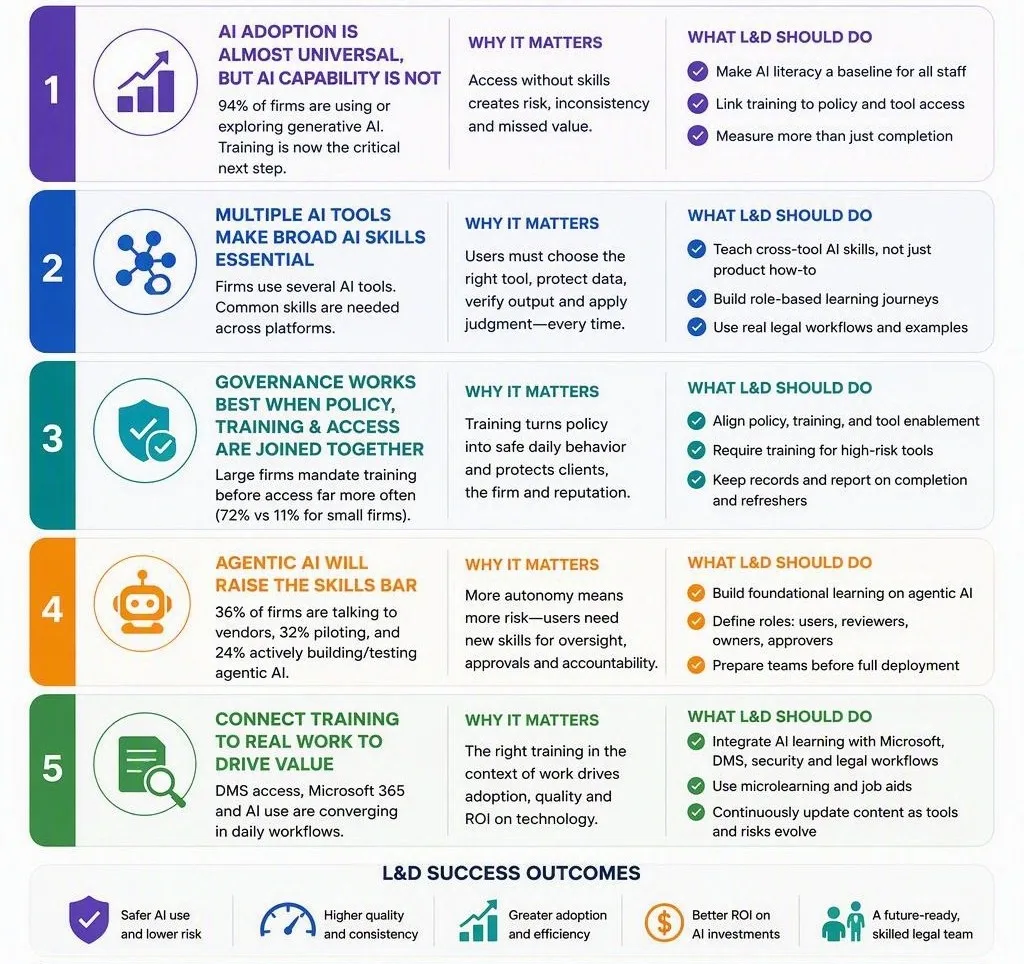
The infographic below highlights the biggest learning and development implications from the 2026 ILTA Technology Survey, showing why AI adoption is shifting the focus from tool access to building AI skills, governance, and real-world capability across legal teams.
Training is part of AI governance
The survey shows a wide gap between small and large firms in the way AI use is governed.
A formal generative AI policy is in place at 57% of firms with fewer than 50 lawyers, compared with 91% of firms with more than 700 lawyers. The gap is even wider for learning. Only 11% of firms with fewer than 50 lawyers require specific AI training before access is granted, compared with 72% of firms with more than 700 lawyers.
This 61-point difference is one of the clearest training signals in the survey.
Large firms may face greater risk, more client demands, and more complex governance. They also have more learning, knowledge, and information security resources. Smaller firms may have less capacity to build their own courses, update them, and track completion.
However, smaller firms do not have less need for safe AI use. They may have fewer people available to catch mistakes and less time to create role-based training internally. This presents a strong case for ready-made, regularly updated AI training in legal that can be rolled out without a large internal course development project.
It also points to a better access model:
Policy sets the rules. Training explains the rules. Completion unlocks access. Reporting shows that the rules have been taught.
A learning management system can bring those parts together. It can assign learning by role, record completion, support refresher training, and give leaders evidence that people received the required guidance.
Agentic AI will raise the skills bar again
Generative AI responds to a request. Agentic AI can plan and take a series of actions to work towards a goal. That difference matters in legal work. The more an AI system can do, the more important it becomes to understand its permissions, source data, limits, and points of human control.
The ILTACON session indicated that 36% of firms were talking to vendors about agentic AI, 32% were experimenting or running pilots, and 24% were actively building or testing AI agents.
Agentic systems could support multi-step work across documents, email, knowledge sources, and business systems. Yet every added action creates another place where context may be misunderstood, data may be exposed, or an error may pass into the next stage.
Agentic AI therefore creates several new learning needs:
- People must understand when an agent is acting rather than only answering.
- Teams must know which actions need human approval.
- System owners must manage access and permissions.
- Reviewers must understand how to inspect the work completed.
- Leaders must decide who remains accountable for the result.
Firms do not need to wait for full agent deployment before starting this work. Basic learning can help legal and business teams understand the concept, spot suitable use cases, and ask better questions during vendor reviews.
Document access is the next AI decision
AI becomes more useful when it can work with trusted firm knowledge and documents. It also becomes more sensitive.
The session shared that 59% of respondents did not yet have access to AI features embedded in their document management system because those features were unavailable or had not been enabled. They also suggested that 32% planned to allow third-party AI tools to access documents within the next 12 months, while another 32% had no plans to do so.
This split shows that the next phase of adoption will not be one simple move. Some firms will connect AI to content quickly. Others will hold back because of security, client terms, data quality, or information governance.
Document management is also shaped by firm size. The session notes identify iManage as more common among large firms and NetDocuments as more common among small firms. That creates a practical training need. Users must understand not only the document management system, but how its AI features interact with profiles, permissions, matter workspaces, search, and document security.
Intellek already provides training content on legal document management systems. This gives firms a way to support both the system and the skills around it, rather than treating AI as a separate topic.
MS makes joined-up learning essential
Microsoft is becoming the common layer beneath much of the legal technology stack.
Windows 11 (as the main operating system) rose from 55% to 95% in one survey cycle. More than 75% of professional staff now use laptops on average. Cloud-hosted email, document management, and Microsoft SharePoint have also continued to grow. The session at ILTACON also put Microsoft Intune use for device management at 39% and cloud-hosted email around 90%, with 87% of firms having email in the cloud or moving it there within 12 months, mainly through Outlook365.
This Microsoft footprint makes Copilot AI training part of a wider learning journey for law firms. A user’s AI skills are connected to their Outlook, Teams, Word, document, and security habits. For firms, this means separate courses should not become separate learning plans. Copilot, Microsoft 365, document management, security, and AI governance should reinforce one another.
Lower resistance ≠ less need for support
User acceptance of change remains one of the top technology issues reported by firms, but it has fallen from 45% in 2025 to 32% in 2026. At the same time, concerns over the high cost of technology have risen from 31% to 38%.
The fall in resistance may sound like good news, but it should not be read as proof that users are ready to work effectively with AI.
Acceptance measures willingness. Capability measures whether someone can perform the task. A person can be keen to use AI and still lack the skills to use it well.
Training can also help with cost. As AI pricing moves towards usage-based models, firms need people to select the right tool, avoid waste, and use paid features for work that creates value. Buying more licences will not fix low capability. It may simply increase the cost of unclear use.
The survey says features and integration lead software purchasing decisions, while ease of use and cost carry less weight, according to the session notes. Firms should add a further question to their buying process: can our people learn and adopt this tool at scale?
The best AI feature has little value if users cannot find it, trust it or apply it to their work.
How do firms choose training partners?
Law firms comparing legal AI training providers should look beyond the length of the course catalogue. A useful partner should be able to support broad AI literacy, product skills, and the systems around legal work. The learning should use plain language, reflect legal risks, and be easy to update as tools change.
Key questions include:
- Does the training cover AI skills as well as application training?
- Can content be assigned by role, access, or practice need?
- Does it explain confidentiality, verification, and human review?
- Can the provider support Microsoft, DMS, and legal workflow training?
- Can the firm track completion and provide evidence to stakeholders?
- Is the content updated when products and risks change?
- Can learning be delivered through the firm’s current LMS?
NOTE: The answer to all of these questions is yes for Intellek’s AI Training for Lawyers.
These are decision-stage questions because the training model affects long-term cost. A firm may buy a low-cost generic AI course but spend far more in time and resources adapting it, managing updates, or producing separate content for a use case.
Where Intellek’s AI training for legal fits
Intellek helps law firms, legal teams, and legal tech vendors build the skills needed around their technology. Our role goes beyond showing users how one AI product works. Intellek’s training catalogue can connect AI learning with Microsoft 365, document management, security awareness and the other systems people use throughout the working day.
The new AI Training for Legal Professionals learning bundle is designed to help close the gap identified in the survey: firms are adopting several AI tools, but users need common skills, clear rules and practical guidance that works across those tools.
For law firms, this supports safer adoption and a more consistent user experience. For corporate legal teams, it gives people a shared base for working with AI in a legal setting. For legal tech vendors, it provides a way to support customers with structured product education and wider AI skills.
Firms can use our SCORM-compliant content within their existing learning environment or combine it with Intellek LMS to auto-assign courses, deliver learning paths, track completion, and manage ongoing learning.
That creates one connected model:
The LMS manages learning. eLearning builds skill. Reporting provides evidence. Better skill improves technology value.
AI training is part of LegalTech strategy
The 2026 ILTA Technology Survey shows that generative AI has passed the adoption threshold. The next challenge is organisational capability.
Firms need governance, secure data, suitable technology and clear leadership. They also need people who understand what the tools do, where the risks sit, and when human judgement must take over.
AI will change legal work, but training will decide if that change is useful, safe and worth the cost.
The survey’s own conclusion is that the strongest results will not come from technology alone. Performance will depend on governance, data discipline, training, security, and leadership support – all working together.
AI tools will keep changing. Strong learning habits, sound judgement, and clear controls will last longer.
FAQs about AI Training in Legal
AI Training in Legal
Course completion is a starting point, not the final measure. Firms can also track user confidence, policy breaches, help requests, adoption by use case, and the quality of reviewed output. The aim is not simply to prove that a course was opened. It is to show that users can make safer, faster and better-informed decisions.
Smaller firms can use ready-made legal AI eLearning rather than building every course internally. A structured bundle reduces development time and can provide more consistent coverage across AI skills, security, and common legal systems. An LMS can automate enrolment, reminders, and reporting – reducing the work placed on a small IT or learning team.
AI training should be reviewed whenever the firm changes its policy, enables a major feature, or adds a new tool. Firms should also provide short refreshers as risks, use cases, and working practices change. An annual course may support compliance, but regular, focused learning is more likely to improve day-to-day capability.
Legal tech vendors should make learning part of implementation rather than leaving it until after launch. Product education should explain not only features but also suitable use cases, limitations, data handling, and points of human review. Vendors can work with a legal learning partner like Intellek to provide structured customer education without having to build and maintain a full training operation internally.
Not on its own. Copilot training can show people how to work with Microsoft’s AI assistant, but staff still need broader AI literacy, data-handling rules, and verification skills. Those core skills also apply when users move between Copilot, legal research tools, document review platforms and AI features inside a DMS.
For higher-risk tools and workflows, training before access is a sensible model. The 2026 ILTA tech survey shows that mandatory pre-access training is already common among the largest firms, with 72% of firms with >700 lawyers requiring specific training before use. Linking training to access gives firms clear control and ensures AI users receive core guidance before handling real work.
Legal AI training should cover basic AI concepts, prompting, confidentiality, approved tools, verification, human review, and practical legal use cases. It should also explain where AI is unsuitable or where extra approval is needed. Product training can then show users how those rules apply within Copilot, CoCounsel, Harvey, or another approved platform.
Legal teams will need to understand how agents plan work, access systems, take actions, and pass results between stages. They will also need to recognize where human approval is required and who remains responsible for the final outcome. The strongest starting point is broad AI literacy, supported by role-based learning for system owners, reviewers and end users.
AI literacy covers skills that apply across tools, such as understanding limitations, protecting data, writing clear instructions, and checking output. AI product training covers the features and workflow of a specific system. Firms need AI skills training to build sound judgement and product training to apply that judgement within each approved tool.
Law firms need AI training because legal professionals make decisions about confidential data, source quality, accuracy, and human review each time they work with an AI tool. Product access does not teach those decisions. Training helps firms turn policy into safe daily behavior. It also helps users find suitable tasks for AI and check the result before it affects a client or matter.

An accomplished Chartered Marketer and content creator with over ¼ century of experience in the field. Alongside marketing the award-winning learning solutions from Intellek, Ricci Masero has been writing about tech and innovation for years – his thought leadership features in Forbes, Entrepreneur, ILTA, Atlassian, and AI Journal. As an author, he is a regular contributor to eLearning Industry, Training Journal, and other industry publications. He is co-host of L&D Insights in Intellek’s webinars and a Vice Chair of Education at the Chartered Institute of Marketing.