A good Law Firm LMS RFP is not a shopping list. It’s the bridge between what your law firm needs and what a vendor must prove. The best RFPs make the buying process clearer by turning business goals, learner needs, integrations, data, security, and implementation scope into evidence that can be compared.
This article is for law firm teams that are reviewing a learning management system, replacing a legacy platform, or trying to bring more order to vendor selection. The main point is simple: if your RFP is vague, vendor replies will be vague. If your RFP is clear, vendors can price the work properly, show the right product fit, and explain what delivery will really involve. That matters because the wrong LMS decision can create years of admin pain, weak reporting, and low adoption. The right RFP helps your firm reduce risk before the contract is signed.
| Highlights |
|---|
| 1. A strong LMS RFP turns vendor claims into evidence. |
| 2. Law firms should define learner groups before they define features. |
| 3. Integrations, data migration, and reporting need detail early, not after selection. |
| 4. Implementation scope is just as important as product functionality. |
| 5. The best vendor is not always the one with the longest feature list; it’s the one that fits the firm’s real use cases. |
Why a Clear LMS RFP is Important
An LMS RFP connects learning needs to system evidence. A law firm learning strategy depends on clear audiences, clear content, clear data, and clear reporting. A vendor response improves when the RFP explains those needs in plain terms. That is the heart of the process. The RFP should not try to trap vendors. It should help the firm see which vendor can support the work, which vendor is guessing, and which vendor needs more detail before making promises.
Law Firm LMS RFP needs more than a feature list
Many LMS RFPs start with a long list of features. That can feel useful, but it often hides the real buying question. The question is not simply, “Does the platform have this feature?” The better question is, “Will this platform support the way our firm trains people, tracks learning, and proves progress?”
A learning management system supports learning administration. A law firm LMS supports legal training operations. Those two statements look close, but they are not the same. A law firm may need to manage onboarding, professional development, compliance training, legal software training, continuing education, client learning, and role-based pathways. Each use case adds different needs for audiences, permissions, content, reporting, and support.
A feature list can tell you whether a function exists. A clear RFP tells you whether that function will solve the problem. For example, “reporting” is too broad. A better requirement says the firm needs completion reports by office, department, practice group, role, and course type. That gives vendors something real to answer. It also gives the buying team a better way to compare replies.
8 Law Firm LMS RFP Essentials
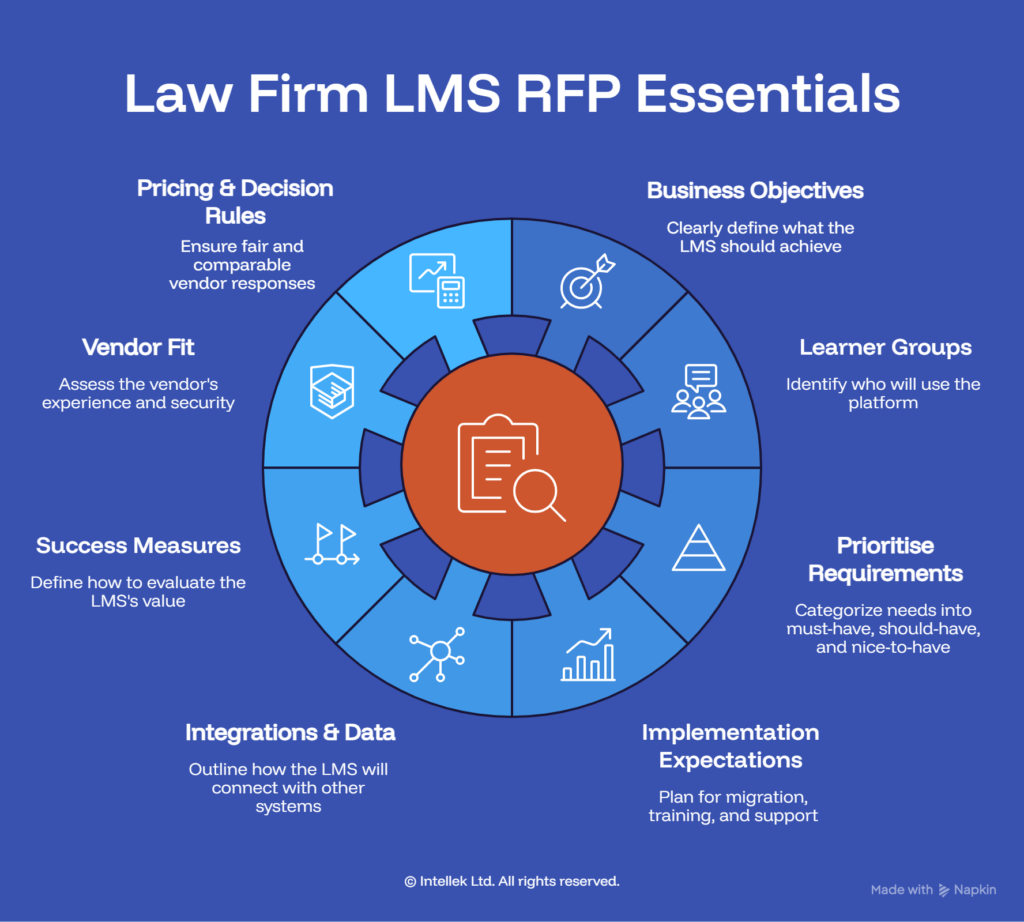
1. Define the business objectives before the system requirements
The first section of the RFP should explain why the firm is buying or replacing an LMS. This does not need to be long. It needs to be specific. A vendor should be able to read the opening section and understand what the firm is trying to improve.
- Business objectives give the RFP direction. The LMS supports the objective. The vendor response should prove how the platform supports that objective. This creates a simple chain of meaning: the firm defines the goal, the RFP turns the goal into requirements, and the vendor explains how the system meets those requirements.
- Useful objectives might include reducing manual admin, improving onboarding, increasing completion of required training, giving lawyers easier access to learning, improving technology adoption, or giving leaders better data. If the firm has several objectives, put them in order. Vendors need to know what matters most.
This section also helps internal stakeholders. Learning teams, IT teams and senior sponsors may use different language for the same problem. The RFP should create one shared version of the buying need.
2. Name the learner groups and the real use cases
A law firm rarely has one learner group. The LMS may support lawyers, trainees, laterals, partners, business services teams, IT trainers, compliance teams, clients or external users. Each group may need a different experience.
The RFP should make those learner groups clear. A vendor needs to know who will use the platform, how often each group will use the platform, and what type of learning each group needs. This is where the RFP moves from abstract software buying to real firm use.
For example, a trainee onboarding pathway is not the same as a short software update for a partner. A compliance course is not the same as a learning path for new business services staff. A client-facing learning portal is not the same as an internal professional development catalogue. The LMS connects people to learning. The RFP should show which people need which learning.
3. Prioritise requirements so vendors can answer honestly
A long requirement list is not always a strong requirement list. If everything is marked as important, nothing is important. Vendors will often respond with broad yes or no answers, and the buying team may find it hard to tell where the real fit sits.
A better approach is to group requirements by priority:
- Must-have requirements are the items the firm cannot go without.
- Should-have requirements are important but may allow a workaround.
- Nice-to-have requirements can add value but should not drive the decision.
This helps vendors give more useful answers. It also helps the firm avoid paying too much attention to features that do not support the core use case. The RFP governs the vendor comparison. Prioritised requirements make that comparison fairer and faster.
This is also useful when a vendor cannot meet a requirement exactly. A good response should explain the gap, the workaround, the cost and the impact. That is much more useful than a simple “yes”.
4. Document integrations, data and migration needs early
Integration work can change the cost and shape of an LMS project. That is why the RFP should state the systems the LMS must connect with and the data the firm needs to move. This should happen before vendor selection, not after it.
- Common law firm integration points may include Microsoft 365, Teams, Outlook, SSO, HR systems, DMS, content libraries, and reporting tools. The exact list will vary by firm. The key point is that the vendor should not have to guess.
- Data migration needs the same level of care. A firm may need to move learner profiles, course records, completion history, certification data, attendance records, groups, departments, and training content. The more detail the firm gives, the better the vendor can scope the work.
The LMS stores learning data. The HR system stores people data. The integration connects the two. That sentence is simple, but the work behind it can be complex. Your RFP should ask vendors to explain the method, timing, ownership, and testing approach for each integration or migration activity.
5. Set clear reporting and success measures
Reporting is one of the main reasons firms invest in an LMS. Yet many RFPs only ask whether the system has reports. That question is too weak. The RFP should explain what the firm needs to know and who needs to know it.
- Compliance teams may need completion evidence. Learning teams may need adoption data. Practice group leaders may need progress by department or office. IT teams may need reports on software training. Senior leaders may only need a summary view that shows risk, progress, and uptake.
- The RFP should also link reporting to success measures. If the goal is to reduce admin, how will that be measured? If the goal is to improve onboarding, what will prove the new process works? If the goal is to improve compliance visibility, what reports need to exist from day one?
A good success measure makes the project easier to defend. It gives the firm a way to judge value after go-live. It also gives vendors a chance to show whether the system can support the reporting model without heavy manual work.
6. Ask for implementation detail, not just platform detail
The LMS buying decision does not end when the contract is signed. In many projects, the real risk appears during implementation. Data needs cleaning. Integrations need testing. Admin roles need setting. Content needs moving. Stakeholders need updates. Users need support.
The RFP should ask each vendor to explain the implementation process in plain terms:
- What happens first?
- Who leads the work?
- What does the firm need to provide?
- How long does each stage take?
- What are the main risks?
- How will testing work?
- What happens after go-live?
Implementation connects the promise to the working system. A vendor that gives a clear implementation plan is easier to assess than a vendor that only talks about features. The firm should also ask for project roles, timelines, training, change support and stabilisation support. Here are some more questions to ask vendors.
7. Evaluate vendor fit beyond the product demo
A good demo can show the product. It cannot prove the whole relationship. The RFP should help the firm evaluate the vendor as well as the platform.
Legal-sector experience matters because law firms have specific training patterns, stakeholder groups, content needs and reporting pressures. Support matters because administrators need quick, useful help when work is live. Security matters because the LMS may hold personal data, training records and user access information. Product roadmap matters because the firm needs to know where the platform is going.
The vendor supports the platform. The support model shapes the customer experience. The roadmap shows future direction. Each of these points affects value after the sale.
The RFP should ask for references, support hours, escalation routes, customer success processes, security evidence, and examples of similar projects. This does not need to be heavy. It just needs to help the buying team see how the vendor works once the sales process is over.
8. Make pricing and decision rules easy to compare
Pricing needs structure. If each vendor prices in a different way, the firm may struggle to compare the real cost. The RFP should ask for clear licence costs, implementation costs, support costs, training costs, optional services, integration costs and any likely future costs.
The RFP should also explain the decision process. Vendors should know the timeline, the response format, the contact rules, the demo expectations and the scoring criteria. This keeps the process fair and cuts down wasted time.
A clear scoring model helps the firm avoid a decision based only on the most polished sales presentation. It also helps vendors focus their response on the parts that matter most. If integration and reporting carry more weight than optional features, say so. If legal-sector experience is important, say so. If implementation support is a key part of the decision, say so.
How the LMS Evaluation Playbook helps
The LMS Evaluation Playbook gives law firm buyers a clearer way to move from early research to vendor comparison. It can help teams gather requirements, align stakeholders, build stronger RFP questions, compare vendors and prepare for implementation.
The Playbook is useful because LMS buying is rarely a single decision. It is a set of smaller decisions about needs, people, data, content, reporting, support and change. A structured guide helps teams make those decisions in the right order.
If your firm is reviewing LMS options, use the Playbook before you issue an RFP. It will help you ask better questions, cut out vague requirements and build a clearer case for the system your firm actually needs. There’s a direct link to the playbook at the end of this article.
Common mistakes that weaken an LMS RFP
The first mistake is making the RFP too broad. A broad RFP creates broad answers. The second mistake is asking for too many features without explaining the use case. The third mistake is leaving data, integration, and implementation questions until after selection.
Another common mistake is failing to involve the right people early. A learning team may own the LMS, but IT, HR, risk, KM, finance, and practice group leaders may all have requirements. If those needs are missed, they can slow the project later.
The final mistake is treating every requirement as equal. A firm should not let a nice-to-have feature outweigh a core need such as reporting, security, data migration, or admin fit. The RFP should protect the project from that kind of drift.
Law Firm LMS RFP FAQs
Legal LMS RFP
A law firm should compare LMS vendors against weighted criteria. The criteria should include fit for use cases, reporting, integrations, data migration, security, implementation support, legal-sector experience, support model, and total cost.
LMS features describe what the platform can do. LMS fit shows whether those features support the firm’s real training needs, workflows, reports, users and systems.
A law firm LMS RFP should include business objectives, learner groups, use cases, prioritised requirements, integrations, data migration needs, reporting expectations, implementation scope, vendor evaluation criteria, pricing structure, and decision rules.
Data migration should be discussed before the RFP is issued. Vendors need to know what records move, where the data comes from, how much history is needed and who will test the migrated data.
The core group usually includes learning and development, professional development, HR, IT, KM, risk or compliance, finance and key business sponsors. The exact group depends on the firm’s structure and goals.
LMS RFPs often get weak responses because they ask broad feature questions without enough context. Vendors need to understand the firm’s goals, systems, data, users, and success measures to give a useful answer.
How can Intellek help with LMS evaluation?
Intellek can help law firms think through LMS requirements, training workflows, content needs and vendor comparison. The LMS Evaluation Playbook is a practical starting point for teams that want a clearer buying process.
Before you send your next LMS RFP, make sure the document does more than ask for features. Use it to explain the firm’s goals, users, systems, data, reporting needs and implementation expectations. Stronger inputs lead to stronger vendor responses.
Sign up for Intellek’s LMS Evaluation Playbook to get practical guidance on requirements gathering, stakeholder alignment, vendor comparison, RFP planning and evaluation scorecards.